Your credentials never leave your network
ispforge is a hosted control plane — but it never stores router credentials in the cloud. A lightweight agent runs inside your infrastructure, holds the NETCONF / SSH / API secrets, and dials out over mutual TLS. The control plane can render and preview config; it can't reach a router without going through your agent.
The SaaS knows the shape. The agent holds the keys.
A deliberate two-party design. The control plane knows which routers exist, which agent owns them, and whether credentials are set — never the secret material itself. Everything that touches a router goes through the agent on your management network.
- Credentials live on the agent — in
auth.yaml, mode0600, readable only by the agent process on your host. - The cloud never sees secrets — Core learns "configured" or "missing" from a heartbeat, nothing more.
- Zero inbound — the agent dials out over mutual TLS; nothing connects into your network.
- A leaked control-plane token can't reach your routers — the blast radius is bounded to whatever one agent manages.
- Step-up gated writes — entering or rotating a credential requires a fresh re-auth, even on a valid session.
Real-time device state, full deploy history
The agent reports live device state — model, version, BGP neighbors — and every deploy it runs is recorded, diffed and auditable.
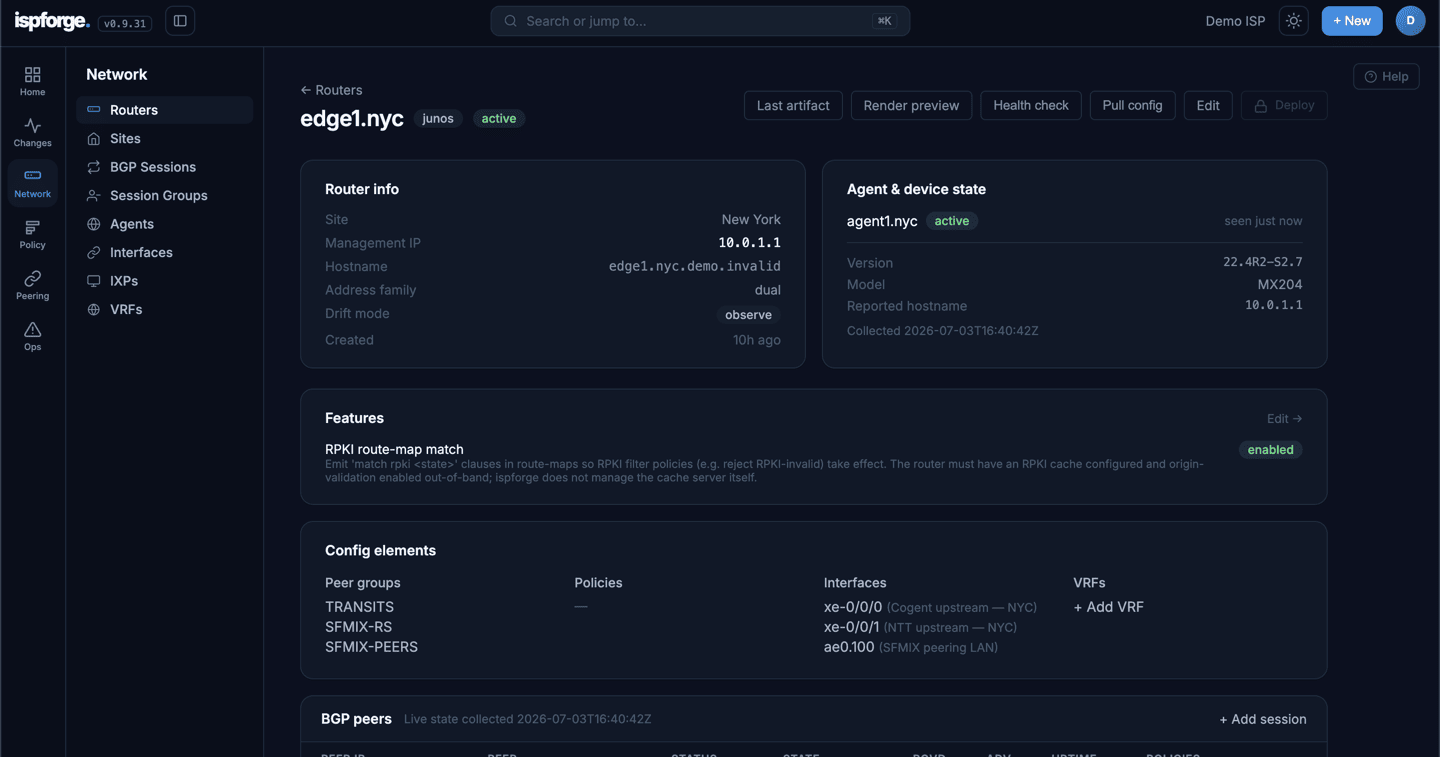
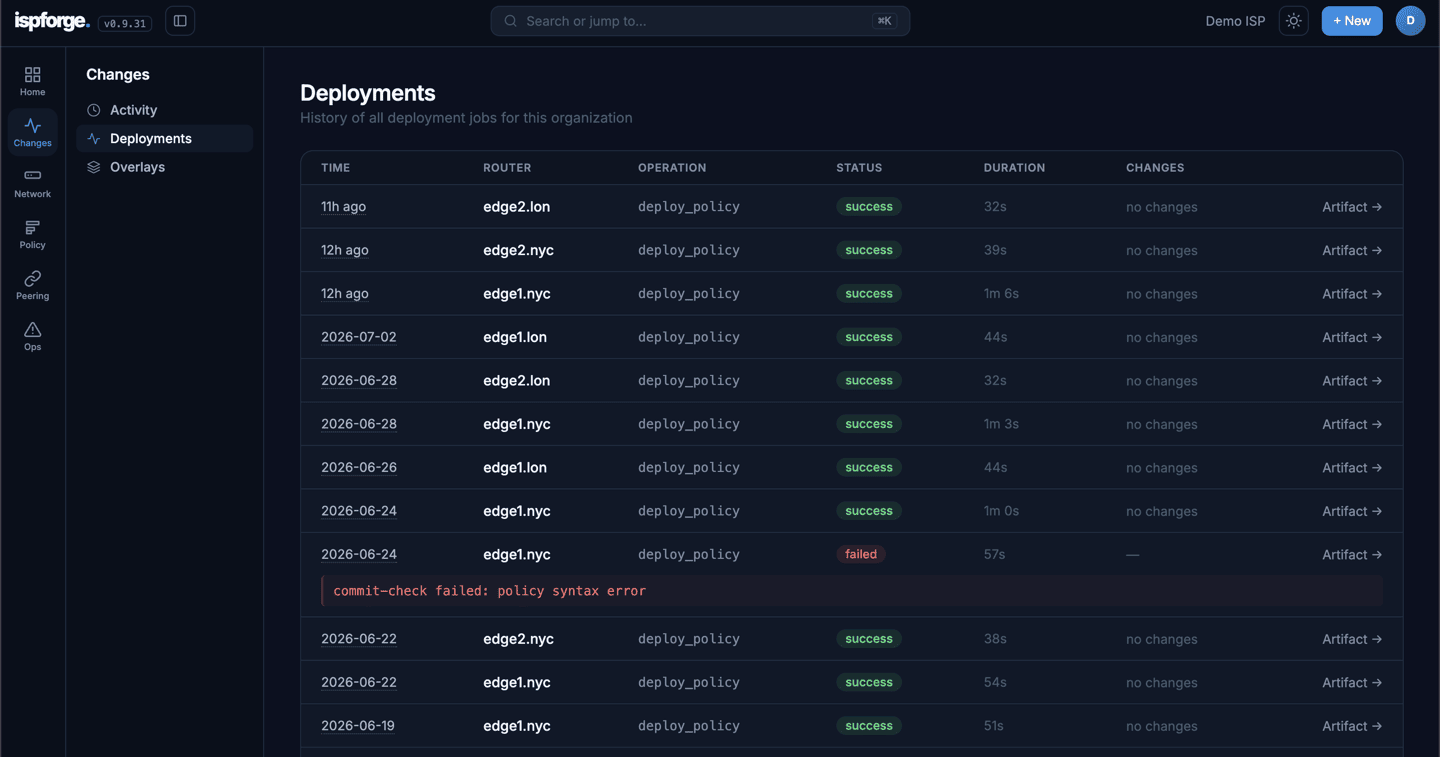
On-prem security with SaaS UX
Two-minute enroll
Run the agent as a container or a .deb; it enrolls with a one-time code and gets its own mutual-TLS cert. Assign routers to it in the portal.
Portal-to-agent SSO
Add credentials from the router's page — a deep-link signs you into the agent's local UI with your portal session, so it feels portal-native while the secret is written locally.
Commit-confirmed
Every deploy previews a diff, then applies transactionally — commit-confirmed on Junos / IOS-XR, scheduled safety-rollback on MikroTik — with rollback armed.
Why not store creds in the portal? A single control-plane compromise would mean fleet-wide router compromise. Agent-local keeps the blast radius bounded.
The convenience of SaaS. The trust boundary of on-prem.
Enroll an agent against a single router — free — and see the split-trust model for yourself.